It would be interesting to view the development of the dump through time via various forms of documentation, i. e. satellite imagery, statistics, video.
Using google earth, there is a function to scroll through the updated satellite images, allowing user's to view a landscape's change over time. it would be interesting to compile the images of the dump in mexico through time lapse and view the dumps changes through the satellite lens.
- what is the annual growth rate of the dump in mexico?
- what can be determined about the dump via satalite imagery?
(Google Earth) http://www.google.com/earth/index.html
- what other forms of documentation can be used to track the evolution of the dump through time?
Djavan Santos
Wednesday, September 29, 2010

Is there something to learn form the dump dwellers?
When I started researching the Bordo Poniente I immediately became curious about the communities that live near or in the dump. Not sure if anyone remembers but I played a brief news piece from NPR about the dump dwellers in one of our first class meetings. I'm always fascinated by the way media delivers information especially when it comes to representing Latin America. The NPR piece was plagued with derogatory words when talking not only about the living conditions but of the people as well. If the dump dwellers are mostly illiterate, and lack political representation, how are their voices heard to the greater public? What can we learn from this community?
http://www.npr.org/templates/story/story.php?storyId=5327140
-Cristina
http://www.npr.org/templates/story/story.php?storyId=5327140
-Cristina
Tuesday, September 28, 2010
Here is a link detailing the geologic history of the mountains surrounding DF, the Trans-Mexican Volcanic Belt.
http://www.mantleplumes.org/Mexico2.html
some beach trash photos of mine
http://www.flickr.com/photos/janesko/sets/72157623617823583/with/4549053547/
some Palo Alto dumpsters and trash
http://www.flickr.com/photos/janesko/sets/72157623800532879/with/4590435901/
-David Janesko
http://www.mantleplumes.org/Mexico2.html
some beach trash photos of mine
http://www.flickr.com/photos/janesko/sets/72157623617823583/with/4549053547/
some Palo Alto dumpsters and trash
http://www.flickr.com/photos/janesko/sets/72157623800532879/with/4590435901/
-David Janesko
Concerning trash...
I have lived in places in the U.S. that are extremely trash conscious, (such as Portland, OR), and other places where there is not even a recycling program in the whole city, (Bisbee, AZ). From my experience- the variation seems to do a lot with community activism and commitment as well as support from the specific state. Assuming the U.S. as a whole is either great or terrible in regards to trash management, is not entirely valid.
- Does Mexico experience something similar? How concerned are people about the trash in their communities?
- I am also wondering how active alternative building projects are that seek to utilize specific kinds of trash as building material? ( Ex.- homes built from old tires or offices from old metal shipping containers)
- How supportive is the Mexican government in providing funding, tax breaks, etc., for independent organizations/projects which attempt to find working solutions for Mexico’s trash?
- Heather R.
Soil and Water Contamination
I am interested in the health of soil and water, and have heard many stories about high levels of toxicity in the Bay Area ("nothing lives in the bay water, because of all the oil spills", "Don't get vegetables at the farmer's market from these farms, they are from an area with toxic soil"...)
I know the dump in Mexico City affects the surrounding elements with runoff and whatnot, so here are some basic questions:
How fertile/toxic is the soil in SF and in MC?
What kinds of toxins are present? Why?
What is being done to clean them up? Where does the contaminated soil go?
What toxins are present in the water supply? How safe/unsafe is the tap water?
Here are some links I found useful in beginning to answer some of these questions:
I know the dump in Mexico City affects the surrounding elements with runoff and whatnot, so here are some basic questions:
How fertile/toxic is the soil in SF and in MC?
What kinds of toxins are present? Why?
What is being done to clean them up? Where does the contaminated soil go?
What toxins are present in the water supply? How safe/unsafe is the tap water?
Here are some links I found useful in beginning to answer some of these questions:
-Ariel H.
More found objects..
C
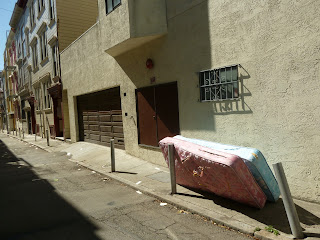
And everyday I walk through the streets of SF there are some objects that appear to be in "good" condition, but discarded...
What about the matresses...would people think about bedbugs in Mexico City (do they have bedbugs there???) or would they just pick them up and give them some good use? Where do these matresses end up in SF?


And everyday I walk through the streets of SF there are some objects that appear to be in "good" condition, but discarded...
What about the matresses...would people think about bedbugs in Mexico City (do they have bedbugs there???) or would they just pick them up and give them some good use? Where do these matresses end up in SF?


Monday, September 27, 2010
Movie from the project Monumentos Menores by Sandra Calvo and Pedro Ortiz Antoranz
Here is the movie Cirujia Plastica (Plastic Surgery) by Sandra Calvo, documenting the repair of a plastic cargo box by El Jarocho, a man who works at the biggest market in Mexico, El Central de Abastos. Even though the box is broken, it is not thrown out, but given a renewed life as a useful and interesting object.
-Mick
-Mick
Subscribe to:
Posts (Atom)